The Reddit Post That Got It Right
“I have a supplier from a factory in China. I have used him for 4 years. I pay him on PayPal.”
That comment on r/Crystals cuts through the noise. Four years. Same supplier. No platform. Just a relationship built on trust.
Compare that to the average Alibaba buyer: scrolling through hundreds of listings, comparing prices that all look the same, wondering who’s actually a factory and who‘s a middleman.
Here’s the reality most sourcing guides won‘t tell you: the platform fee you don’t see is the one that costs you the most.
The $3,000 Order: Side-by-Side Comparison
Let‘s run a real example. You’re ordering 50 medium-sized crystal skulls — a mix of amethyst, rose quartz, and clear quartz. The factory price is $40 per piece, or $2,000 total for the goods.
Channel A: Alibaba
Channel B: Direct Factory (4-year relationship)
The gap: $220–560 on a single $2,000 order. That‘s 11–28% of your product cost — straight into someone else’s pocket.
1. The Supplier Markup (5–20%)
Alibaba suppliers don‘t eat the platform fees. They pass them on. Gold Supplier membership costs $3,000+ per year. Trade Assurance takes another 2–4% per transaction. Add sample costs ($30–300 per round), and you’re looking at 3–5 rounds before production.
The supplier builds all of this into the listing price. That “factory-direct” price on Alibaba? It‘s not factory-direct. It’s factory + platform + marketing + profit.
2. The Quality Roulette
Industry data suggests 15–30% of direct Alibaba orders include some quality issues. When your shipment arrives and half the skulls have cracks or uneven carvings, what do you do?
File a dispute. Wait for Alibaba‘s arbitration. Hope the platform rules in your favour. Meanwhile, your inventory sits empty and your customers wait.
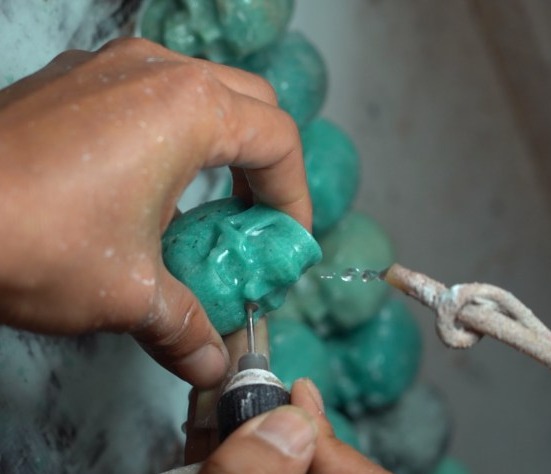
A direct factory relationship skips this. You’ve seen their workshop. You‘ve approved samples in person. You know exactly what you’re getting.
3. The “Who Am I Actually Buying From?” Problem
When you find a supplier on Alibaba, you don‘t automatically get a manufacturer. Many listings are trading companies — middlemen who mark up factory goods and handle the export paperwork.
One industry observer puts it bluntly: “Alibaba still wins on sheer breadth and factory-direct pricing at volume, but it loses on supplier trust, low minimums, and anything custom.”
A direct relationship means you know who‘s cutting your stone.
When Alibaba Actually Makes Sense
Let’s be fair. Alibaba isn‘t useless. It’s the right tool for:
-
First-time buyers who need Trade Assurance protection
-
Small test orders under $500 where the markup is negligible
-
Product discovery — finding suppliers you might later move off-platform
But for repeat orders? For anything over $1,000? The math shifts.
The Direct Factory Advantage
A four-year relationship isn‘t built overnight. But it starts with one order. One sample. One conversation.
Direct factories offer:
-
No platform markup — you pay what the stone actually costs
-
Consistent quality — the same carver, the same standards, order after order
-
Flexible MOQs — because you’re talking to the person who makes the decisions
-
Faster communication — no middleman, no translation delays
That r/Crystals user who‘s been with the same supplier for four years? They’re not lucky. They‘re just not paying for a platform they don’t need.
The Bottom Line
A $3,000 order on Alibaba can cost you $3,300 by the time it hits your door. The same order, direct from a factory you trust, costs $3,000.
The difference isn‘t the stone. It’s the channel.
If you‘re a first-time buyer, Alibaba’s protection is worth the premium. But if you‘re placing repeat orders? Find a factory. Build a relationship. Stop paying for a middleman you don’t need.
The crystal market is projected to reach $13.6 billion by 2035. The question isn‘t whether there’s demand. It‘s whether your margin survives the platform fees.


 English
 Français
 عربي
عربي Deutsch