The Reddit Post That Says It All
“I own a crystal shop and it‘s not going great.”
That post on r/smallbusiness has become something of a cautionary tale in the crystal community. The specifics vary, but the pattern is always the same: a new shop owner blows their entire opening budget on the wrong inventory, then spends months trying to move product that nobody wants.
The global crystal products market was valued at $8.9 billion in 2025 and is projected to reach $13.6 billion by 2035 — growing at 4.4% annually. The opportunity is real. But opportunity doesn‘t pay the rent. Sales do.
Here’s what actually belongs in your first order, broken down by budget.
Before You Buy: The Rule That Changes Everything
Stop buying like a collector. Start buying like a retailer.
Collectors buy what fascinates them. Retailers buy what moves. Most new shop owners blow their first wholesale budget on statement pieces—big amethyst geodes, rare specimens, crystals they would want to own. Then they open the shop and realise those pieces sit on the shelf for months while customers walk out with $5 tumble stones.
Your first order isn‘t about you. It’s about what your customers will actually pay for.
Budget Tier 1: $500 — The Test-the-Water Order
This budget is tight, but it‘s enough to validate your market before you commit more.
What to buy:
-
Tumbled stones — 3–5 kg total, split across amethyst, rose quartz, clear quartz, citrine, and labradorite. These five consistently rank as the top-selling crystals worldwide. Buy by the kilo, not by the piece.
-
Small points and towers — 10–15 pieces in the 2–3 inch range. Clear quartz and amethyst are your safest bets.
-
Palm stones — 5–10 pieces. They’re the natural next step for customers who started with tumble stones.
Budget allocation: ~$250 on tumbled stones, ~$150 on points, ~$100 on palm stones.
What this buys you: A lean, testable inventory that tells you what your customers actually want. If the amethyst moves faster than the rose quartz, you know where to put more weight on your next order.
The trap: Don‘t spend this budget on one or two big pieces. You need variety at this stage, not size.
Budget Tier 2: $3,000 — The Serious Starter
This is where your shop starts to look like a crystal shop instead of a rock collection.
What to buy:
-
Tumbled stones — 10–15 kg, same top five varieties. These are your volume movers and your cash-flow engine.
-
Points and towers — 30–40 pieces, including some 4–6 inch towers. These give you a mid-tier price point.
-
Clusters — 10–15 small to medium amethyst clusters. Clusters look expensive (which means you can mark them up accordingly) but they‘re still accessible to most shoppers.
-
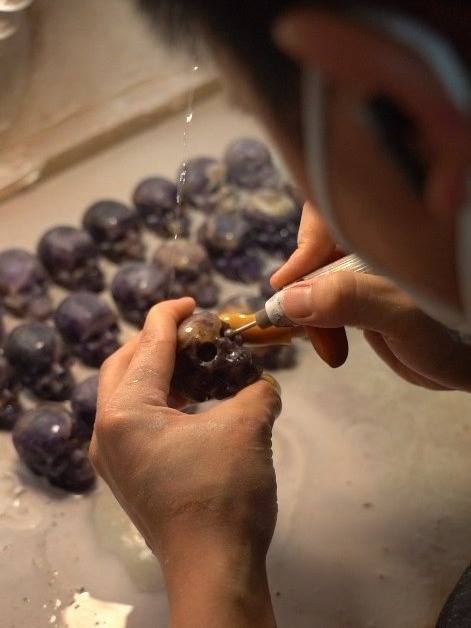
Carved pieces — 5–10 small crystal skulls (2.5–3.5cm) or animal carvings. A small clear quartz skull wholesales for around $95**, and a 3.7-inch obsidian skull goes for about **$28 wholesale.
-
Spheres — 5–10 pieces in the 2–3 inch range. Amethyst and rose quartz spheres are consistent sellers.
Budget allocation: ~$500 on tumbled stones, ~$600 on points, ~$600 on clusters, ~$600 on carvings, ~$400 on spheres, ~$300 on shipping and samples.
What this buys you: A proper shop floor with enough variety to keep customers browsing. You‘re not fully stocked yet, but you have a presence.
The trap: Don’t forget about landed cost. A $10 wholesale cost can easily become a $16 landed cost by the time it hits your shelf. Factor in freight, customs, breakage allowance, and packaging before you set your retail price.
Budget Tier 3: $10,000 — The Full Assortment
This is the budget that gets you a fully stocked shop with room for differentiation.
What to buy:
-
Tumbled stones — 20–30 kg across 8–10 varieties. This is your bread and butter.
-
Points and towers — 50–80 pieces across multiple sizes and materials. Include some higher-end materials like fluorite or labradorite.
-
Clusters and geodes — 20–30 pieces, including some medium-sized geodes that become your shop‘s visual anchors.
-
Carved pieces — 15–25 pieces. Include skulls, animals, hearts, and spheres. This is where your margins get interesting — larger items can yield 4x to 6x wholesale markup, while smaller items can yield 15x to 30x.
-
Jewelry — 20–30 pieces. Necklaces and bracelets in the most popular stones: amethyst, rose quartz, and clear quartz. Jewelry gets worn — every time a customer wears a piece from your shop, they become a walking advertisement.
-
Statement pieces — 3–5 larger items ($100–200 wholesale). These are for visual impact and social media content. Buy them last, after you‘ve confirmed your core inventory is moving.
Budget allocation: ~$1,000 on tumbled stones, ~$1,500 on points, ~$2,000 on clusters, ~$2,500 on carvings, ~$1,500 on jewelry, ~$1,000 on statement pieces, ~$500 on shipping and samples.
What this buys you: A shop that looks complete, with enough depth in each category to satisfy different customer types — from the $5 impulse buyer to the $200 collector.
The trap: The 80/20 rule applies here — 80% of your stock should be proven sellers (tumbles, palm stones, clusters of well-known materials). The other 20% can be higher-risk, higher-reward unique pieces. Don‘t reverse that ratio.
The One Table You Need
Three Mistakes That Will Cost You
Mistake 1: Buying what you like, not what sells. Your personal collection and your shop inventory should be separate things. If you wouldn‘t stock it because it sells, don’t buy it.
Mistake 2: Skipping the sample order. Legitimate suppliers will let you buy samples before a big order. Always test before committing. If a supplier pushes you to buy bulk without offering samples, that‘s a red flag.
**Mistake 3: Ignoring the $20 price point.** Items under $20 are impulse-buy territory — tumble stones, small carvings, pocket stones. They require zero hesitation from customers. Make sure your first order has enough of these to keep your cash flow moving while you figure out the rest.
The Bottom Line
Your first wholesale order isn‘t about building the perfect collection. It’s about testing the market with a lean, strategic inventory that tells you what your customers actually want.
Start with the proven sellers — amethyst, rose quartz, clear quartz, citrine, labradorite. Buy deeper in fewer categories rather than shallow across dozens. And for the love of good business, don‘t blow your budget on statement pieces before you’ve confirmed that anyone in your area will actually buy them.
The crystal market is growing. But growth doesn‘t pay the bills — sales do. Stock what sells, and the collection will build itself.


 English
 Français
 عربي
عربي Deutsch