The global crystal products market is estimated at USD 6.1 billion in 2025 and is projected to reach USD 8.4 billion by 2035. With China's Donghai County alone accounting for over 60% of global crystal bead and decorative mineral output and hosting over 500 crystal processing facilities, the supply chain is vast—and so is the opportunity for misrepresentation.
For B2B buyers, the difference between sourcing from a genuine factory and a trading company pretending to be one can mean a 15–30% markup, loss of quality control, and zero legal leverage when things go wrong. This report outlines five red flags that reveal whether your supplier is a real factory or a middleman in disguise.
Red Flag #1: The Bank Account Doesn't Match the Factory Name
This is the single most telling sign. You've been communicating with "Shenzhen ABC Manufacturing Co., Ltd."—but when the invoice arrives, the payment beneficiary is a different legal entity entirely.
The pattern is common: a sales rep claims to be the factory, but payment goes to a trading company registered in Hong Kong or an offshore entity. Sometimes this is legitimate (factories using Hong Kong entities for foreign exchange convenience), but often it signals that you are not paying the factory—you are paying a middleman.
What to do: Request the supplier's mainland China business license. A real factory will have a mainland business license with a factory address. If the supplier can only provide a Hong Kong registration or no manufacturing entity at all, proceed with extreme caution.
Red Flag #2: No Verifiable Physical Factory Address
Real factories occupy real space. Donghai County alone is home to over 30,000 enterprises involved in crystal mining, cutting, polishing, and design. Pujiang County hosts over 1,000 crystal-related enterprises. These are tangible, visitable locations.
A trading company, by contrast, may operate from a commercial office or even a residential address. When you ask for the factory address, watch for vagueness: "near Donghai" or "in the industrial zone" without a specific street address.
What to do: Use mapping tools like Google Maps or Baidu Maps to verify the address. Look for satellite images showing actual factory buildings, not office towers. Ask for a live video call walking through the production floor—trading companies that refuse this are often hiding something.
Red Flag #3: Suspiciously Low Registered Capital
In China, business registration records are public. Registered capital is a rough indicator of financial commitment—starting a factory takes significantly more money than starting a trading company.
A trading company may have registered capital of just a few thousand USD. A real factory, with equipment, facilities, and payroll, will have substantially higher registered capital.
What to do: Search the supplier's registered name on China's National Enterprise Credit Information Publicity System or use third-party verification services. If the registered capital is unusually low for a claimed "manufacturer," treat it as a warning sign.
Red Flag #4: Generic Product Photos and No Production Evidence
Trading companies often use stock photos or images taken from other factories. They may have beautiful product catalogs but no evidence of actually producing anything.
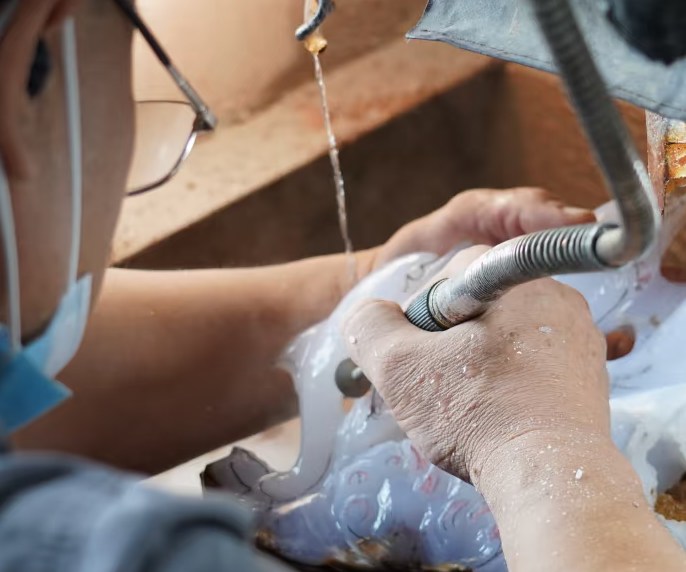
Real factories can show you:
What to do: Ask for photos or videos of your specific order in production—not generic factory shots. Request batch-specific testing data, including hardness (Mohs scale) and clarity grading. Top-tier suppliers will readily provide third-party assay reports from organizations like SGS or Bureau Veritas.
Red Flag #5: Business Scope That Says "Trading" Not "Manufacturing"
A company's registered business scope—the activities it is legally permitted to conduct—is publicly available information. If the scope mentions "import and export," "trading," or "wholesale" but does not explicitly include "manufacturing" or "processing," you are dealing with a trading company.
Some trading companies deliberately register with broad scopes to appear more capable than they are. Others are upfront but still present themselves as factories in sales conversations.
What to do: Request the supplier's business license and read the registered business scope carefully. If manufacturing is not listed, ask directly: "Are you a factory or a trading company?" A reputable trading company will admit it; a dishonest one will deflect.
Quick Reference: Factory vs. Trading Company Signals
Why This Matters: The Real Cost of a Fake Factory
When you unknowingly buy from a trading company posing as a factory, you lose more than just money:
-
15–30% hidden markup on every order
-
No direct relationship with the actual manufacturer—you cannot escalate problems
-
No legal leverage—your contract is with the trading company, not the factory
-
No supply chain transparency—the trading company can switch factories without telling you
-
No design protection—your custom designs can be sold to other buyers
Final Recommendation
The global crystal market is growing—but so is the number of intermediaries looking to capture margin without adding value. A trading company that is honest about its role can still be a valuable partner, offering consolidated sourcing and quality control services. The danger lies in those that impersonate factories.
Before placing your first large order:
-
Verify the bank account matches the factory name
-
Confirm the physical address shows a real production facility
-
Check registered capital and business scope
-
Request production-stage photos or video calls
-
Ask for third-party lab reports on material authenticity
Real suppliers sell repeatability. Anonymous sites sell vibes. Verify before you buy.


 English
 Français
 عربي
عربي Deutsch