The crystal carving market is undergoing a quiet but significant transformation. As automation penetrates the manufacturing sector—The application proportion of CNC engraving equipment in the field of handicrafts has reached 19%, and the penetration rate of industry automation has increased from 34% in 2024 to 41%—the distinction between hand-carved and machine-made crystal pieces has become both more pronounced and more critical for B2B buyers serving premium clientele.
For wholesalers and retailers catering to high-end collectors, luxury decorators, and discerning gift buyers, the ability to articulate the value proposition of master-grade hand-carved crystals is not merely a marketing advantage—it is a commercial necessity. This report examines the data behind the hand-carved premium, the tangible differences between the two production methods, and practical strategies for communicating this value to your most demanding clients.
1. The Market Context: Why the Distinction Matters Now
The global crystal products market is substantial and growing. Market estimates place the sector at USD 12.23 billion in 2025, with projections reaching USD 15.15 billion by 2031 at a compound annual growth rate of 3.6%.
Within this broader market, the handcrafted segment is expanding at an even faster pace. The global handcrafted jewelry market—a useful proxy for artisan crystal carving—was valued at USD 20.07 billion in 2024 and is forecast to reach USD 27.73 billion by 2031, a CAGR of 4.8%.
This growth reflects a fundamental shift in consumer behaviour. High-end buyers are increasingly prioritising authenticity, uniqueness, and artisanal provenance over mass-produced uniformity. According to industry surveys, over 65% of high-end crystal buyers report that hand-engraved designs increase the perceived value of a product by at least 30%.
For B2B buyers, this means one thing: the premium your clients are willing to pay for hand-carved pieces is not arbitrary—it is grounded in measurable consumer preference.
2. The Production Reality: What "Hand-Carved" Actually Means
Before discussing value, it is essential to understand what hand-carving entails—and what it does not.
The Technical Challenge
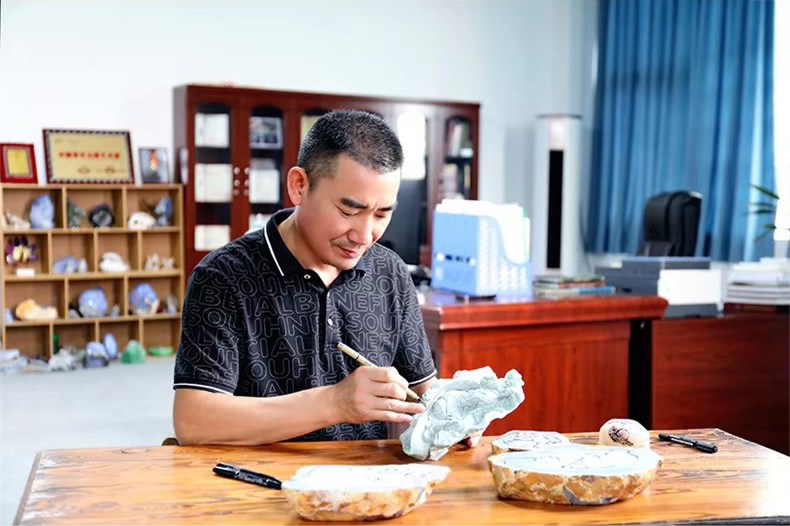
Natural crystal ranks 7 on the Mohs hardness scale. This means it cannot be shaped with ordinary blades or knives. Hand-carving crystal requires specialised rotary tools, diamond-coated bits, and years of accumulated skill. The process is exclusively subtractive—once material is removed, it cannot be restored.
A master lapidary must work around the stone‘s natural inclusions, fractures, and colour variations, making real-time decisions that no machine can replicate. This is not assembly-line work; it is interpretive sculpture.
The Machine-Made Reality
Machine carving—typically executed via CNC equipment or ultrasonic carving systems—operates on fundamentally different principles. A digital model is fed into the machine, which executes the carving with perfect symmetry and mechanical consistency.
The result is technically precise but aesthetically uniform. Every piece from the same mold is identical. There are no tool marks, no surface variations, and—critically—no evidence of human decision-making in response to the stone‘s unique character.
Some products described as “hand-carved” in large-scale production are, in reality, machine-dominant with only minor human finishing. This distinction matters enormously when justifying premium pricing to informed clients.
3. The Price Premium: Data-Driven Reality
The 3×–8× Multiplier
The most significant labour multiplier in crystal carving is the hand-versus-machine distinction. Hand carving requires a master lapidary to work around the stone‘s inclusions, often resulting in a 3× to 8× price premium over mass-produced CNC or ultrasonic carvings.
This is not a marketing markup—it is a reflection of labour intensity. A skilled carver may spend days or even weeks on a single complex piece. Machine production, by contrast, can replicate the same design in hours.
Comparative Cost Structure
Data compiled from industry analysis and gemstone trade sources.
Complexity as a Cost Driver
Beyond the hand/machine distinction, carving complexity itself drives significant cost variation. A simple form may take hours; a multi-layered rose or detailed animal totem can increase labour time by 400% to 600% , resulting in a 4× to 6× difference in final price.
When hand-carving meets high complexity, the result is a piece that cannot be economically replicated by machine—and commands a corresponding premium.
4. What Your High-End Clients Are Actually Buying
When a collector or luxury buyer chooses a hand-carved crystal over a machine-made alternative, they are purchasing more than an object. Understanding this is the key to effective communication.
Uniqueness and Exclusivity
No two hand-carved crystals are identical. The carver‘s response to the stone’s natural characteristics ensures each piece is singular. For high-end clients, this exclusivity is often the primary purchase driver. Mass-produced pieces, by definition, cannot offer this.
Artisanship and Heritage
Hand-carving crystal is a tradition that spans centuries. When a client purchases a master-grade piece, they are acquiring not just a decorative object but a connection to a lineage of craftsmanship. This narrative dimension is particularly powerful in markets like Europe, where heritage craftsmanship carries significant cultural weight.
Investment Potential
Well-maintained or rare hand-carved crystal specimens can appreciate significantly in value over time, particularly as natural crystal resources become more limited and demand for authentic artisan work rises. Machine-made pieces, by contrast, are consumable goods—reproducible and therefore not collectible in the same sense.
The Human Touch
This is the most intangible but arguably most important factor. As one industry observer notes, handcrafted pieces carry “multiple layers of energy and meaning”. For clients who value the spiritual or emotional dimensions of crystal, the human element is non-negotiable.
5. Practical Strategies for B2B Buyers
How to Identify and Source Authentic Hand-Carved Pieces
Not everything labelled “hand-carved” is what it claims to be. When sourcing for high-end clients, verify:
How to Communicate Value to Clients
When presenting hand-carved pieces to high-end buyers, frame the conversation around these points:
-
The 3×–8× premium is justified by labour, not margin: Explain the weeks of skilled work behind each piece
-
Emphasise uniqueness: No two pieces are alike—this is the opposite of mass production
-
Tell the carver‘s story: Where were they trained? How long did the piece take?
-
Highlight the stone’s natural character: Machine carving ignores inclusions; hand-carving works with them
-
Position as investment, not expense: Collectible pieces hold or appreciate in value
Pricing Strategy Considerations
For B2B buyers, the hand-carved premium represents both a cost and an opportunity. While wholesale acquisition costs are higher, the retail margin potential is correspondingly greater. High-end clients are willing to pay for what they perceive as authentic, unique, and artisanal—and they have the data to support that perception.
6. Outlook
The automation of crystal manufacturing will continue. CNC penetration and Hybrid technology (combining manual carving and digital modeling) are becoming industry norms. But this does not diminish the value of hand-carved master-grade pieces—it enhances it.
As machine-made products become more common and more uniform, the distinction between mass production and master craftsmanship becomes sharper. For B2B buyers serving premium markets, this distinction is not a challenge to be managed but an opportunity to be leveraged.
The clients who value hand-carved crystals are not price-sensitive in the conventional sense. They are value-sensitive. And the value they seek—uniqueness, artisanship, investment potential, human touch—is precisely what hand-carved master-grade crystals deliver.


 English
 Français
 عربي
عربي Deutsch